Bengal Cats: A Wild Look With a Friendly Nature
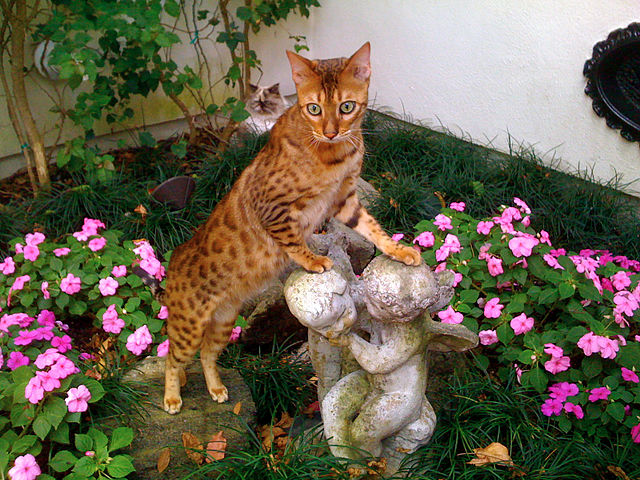
Few domestic cats turn heads like the Bengal. It is a hybrid variety with a distinctly wild look, yet it is homely and friendly by nature. Bengals are also intelligent, alert and very good at sports. Their distinctive markings, spots and rosettes, closely resemble those of the Asian Leopard Cat, and the word ‘Bengal’ comes from that wild ancestor's taxonomic name.
Appearance
Bengals have an average build. Males weigh up to fifteen pounds and females up to ten pounds. The horizontal lines on the sides of the face, which start at the corners of the eyes and run back towards the neck, are known as mascara. The body is usually spotted with rosettes, although some Bengals have a marbled coat pattern. Cats with spots of more than one colour are the most in demand, and the spots range from rust to chocolate brown, cocoa, grey and black. The tail, hind legs and forelimbs carry symmetrical stripes.
Thanks to their looks, intelligence and friendly nature, Bengals win championships in many competitions held to award the most exotic pet.
Origins
The Bengal is the result of years of selective crossbreeding. Jean Mill of the United States developed the breed in the 1970s, crossing the small Asian Leopard Cat (ALC) with domestic cats such as the American Shorthair, Egyptian Mau, Ocicat, Abyssinian and other shorthaired pets. The outcome is a cat with a wild, exotic look and a friendly temperament. Breeders around the globe are still working to develop more qualities in the breed.
The first three generations of offspring are known as the foundation generations. Most of the males in these generations were unable to reproduce, while the females were fertile. After the fifth generation, breeders stopped crossing with other cats and bred two Bengals together instead.
Related Breeds
Bengals have also helped to inspire a few related breeds that are kept as pets: the Cheetoh, the Toyger and the Serengeti.
- Cheetoh: a hybrid produced by crossing the Ocicat and the Bengal, resulting in a spotted cat.
- Toyger: a hybrid produced by crossing domestic pets to create a cat with tiger-like stripes.
- Serengeti: a cat produced by crossing Siamese or Oriental cats to create a look similar to the African Serval.
Colours and Patterns
Based on their patterns, Bengals are described as brown marbled tabby, brown spotted tabby, seal mink marbled tabby, seal mink spotted tabby, seal sepia marbled tabby, seal sepia spotted tabby, seal marbled lynx point and seal spotted lynx point.
Blue Bengals are no longer the unrecognised outsiders they once were. The Cat Fanciers' Association (CFA) breed standard now lists blue tabby and blue silver tabby colours. The International Cat Association (TICA) recognises blue too, although blue Bengals cannot yet compete for championship status there. Bengals are also seen in grey and black, but these colours are still not widely recognised.
Temperament and Care
Unlike most domestic cats, Bengals are fascinated by running water and are easy to bathe. They are drawn to taps and showers and will often jump straight into the tub. They can also be encouraged to vocalise to interact with their owners. They enjoy sports, play hide and seek, and learn games very well.
Young Bengals need human attention, and you can bond with them by playing for at least an hour during the day and again in the evening. They are attention seekers who try to join in every human activity. They follow their owners around, but they do not like being placed on laps.
Anyone thinking of keeping a Bengal should be prepared to spend a lot of time with the cat. A bored Bengal can become frustrated and cause a great deal of trouble. Their energy levels are very high, and the only way to release that energy is to keep them occupied with activities. Owners who cannot spare the time should consider keeping Bengals in pairs so that they can play together. Both cats need equal attention, otherwise the neglected one tends to become envious of the other.